
Tech Talk
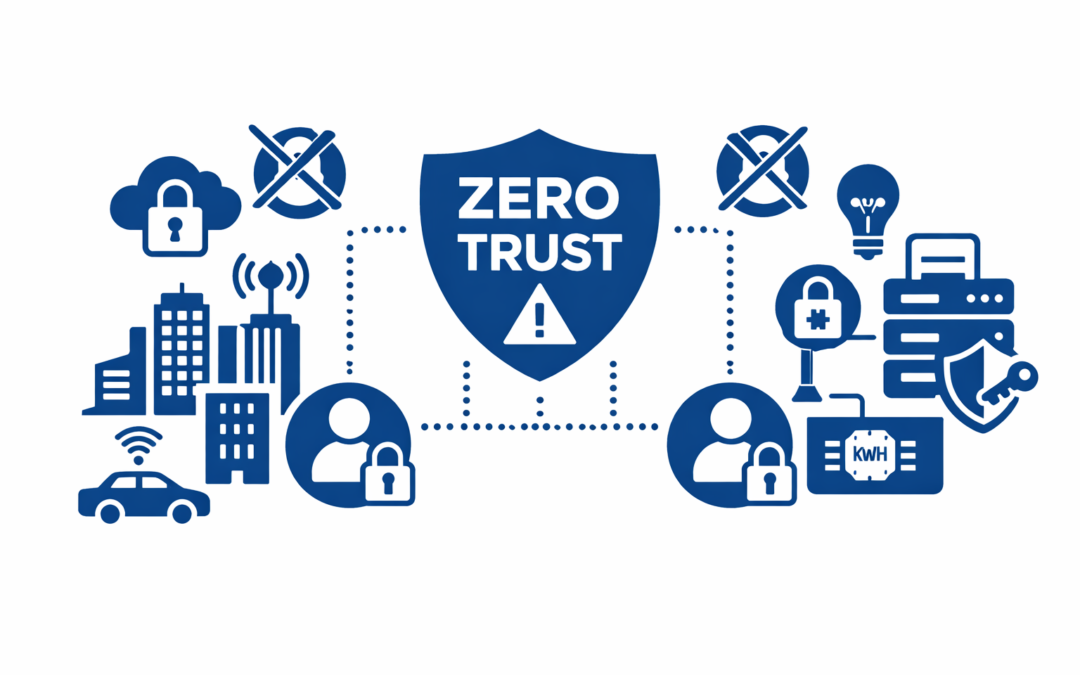
Zero-Trust IoT Security for Smart Cities
Executive Summary
This white paper presents a comprehensive guide to implementing zero-trust security in smart city IoT deployments. With thousands of interconnected devices such as street-light controllers, gateways, and cloud platforms, the attack surface expands dramatically. Traditional perimeter-based defenses are insufficient. Instead, zero-trust IoT security enforces continuous authentication, contextual authorization, micro-segmentation, and continuous monitoring to ensure every device, user, and service is verified at all times.
Core Principles of Zero-Trust IoT
1. Never Trust, Always Verify
-
- Every device, gateway, and user must authenticate before accessing any resource.
- Use per-device certificates issued by a trusted Certificate Authority.
- Enforce runtime verification through attestation.
2. Least Privilege Access
-
- Apply role-based access control (RBAC) and attribute-based access control (ABAC).
- Limit each device to only the minimal set of actions necessary.
- Prevent lateral movement by restricting privileges.
3. Continuous Verification
-
- Credentials must be short-lived and re-issued dynamically.
- Gateways and cloud services must re-verify devices periodically.
- Runtime attestation ensures firmware and configuration integrity.
4. Segmentation & Micro-Perimeters
-
- Divide mesh networks into zones.
- Each gateway enforces micro-perimeter boundaries.
- Unauthorized traffic between zones is blocked by policy.
5. Observability & Threat Detection
-
- Collect telemetry from devices and gateways.
- Feed logs into SIEM/SOC systems for anomaly detection.
- Detect nonce reuse, replay attempts, or rogue device joins.
Best Practices for Zero-Trust IoT
- Identity-first onboarding: Every device provisioned with unique cryptographic credentials.
- mTLS for gateway-cloud links: Ensure both endpoints mutually authenticate.
- End-to-End Encryption (E2EE): Use COSE/OSCORE at the application layer.
- Policy-as-Code: Define access control in machine-readable policies (e.g., OPA/ABAC engines).
- Runtime Attestation: Gateways verify device firmware state using TPM/DICE evidence.
- Adaptive Security: Access dynamically adjusted based on behavior and risk scoring.
Smart City Example
- Street-Light Controllers (SLCs): Each has a unique X.509 identity, onboarded securely.
- Mesh Network: Zigbee/BLE Mesh secured with unique AppKeys and NetKeys.
- Gateways: Enforce local segmentation and only forward authorized data.
- Cloud: Issues short-lived session tokens, applies fine-grained ACLs, and verifies logs continuously.
Compliance Mapping
- NIST SP 800-207: Zero-Trust Architecture guidelines.
- ETSI EN 303 645: IoT access control and identity security.
- IEC 62443: Micro-segmentation and least privilege enforcement.
Conclusion
Zero-trust IoT represents the next evolution in smart city cybersecurity. By rejecting implicit trust, enforcing continuous identity verification, and applying contextual authorization, municipalities can protect critical infrastructure against advanced cyber threats. This approach ensures resilience, scalability, and compliance while future-proofing smart city IoT ecosystems.
CategoriesUncategorized
TagsZero-trust IoT security, smart city cybersecurity, IoT micro-segmentation, IoT continuous authentication, IoT runtime attestation, zero-trust architecture for IoT
Ciight Announces the Real Estate Agent Sales Tool
Ciright is happy to announce the Real Estate Agent Sales Tool. Now, a Real Estate Agent can track their listings, their targets, and all opportunities in their geographical territory so that they can easily run comps, begin to nurture relationships with people who are...
Enhance Customer Service with Ciright Case Management
Ciright announces integration of all Customer Service Case Management. Once a customer service case is opened, it is then indexed to a customer and/or a company. Through integration with System One the case is spread throughout the company for total visibility and...
Ciright Committs to the Power of the Cloud
Since announcing its hosted application, Ciright has been overhwelmed with the enthusiastic response of its customers to this software solution. Following our customers' lead, Ciright recognizes and commits to the power of the cloud. The company is changing its...
Gain Total Visibility With Pipeline Trend Reporting
Ciright is proud to add the Pipeline Trending Reporting Function to System One. This additional functionality will provide visibility of the historical activity by sales representative, revenue line, department, or team. Pipeline trending allows an organization to...
Ciright Introduces Call Log Integration
Ciright announces availability and integration of Call Log Integration for enterprise phone systems to retrieve the call log information from a call center and/or office environment, as well as the correlated activity by personnel, including inbound and outbound...
Ciright Develops Message Dissemination Application
Ciright develops the Message Dissemination Application, also known as MDA, which allows for the dissemination of real time information. This information includes text, email, and facts that are sent to all parties involved with a particular opportunity or project....
Recent Comments