
Tech Talk
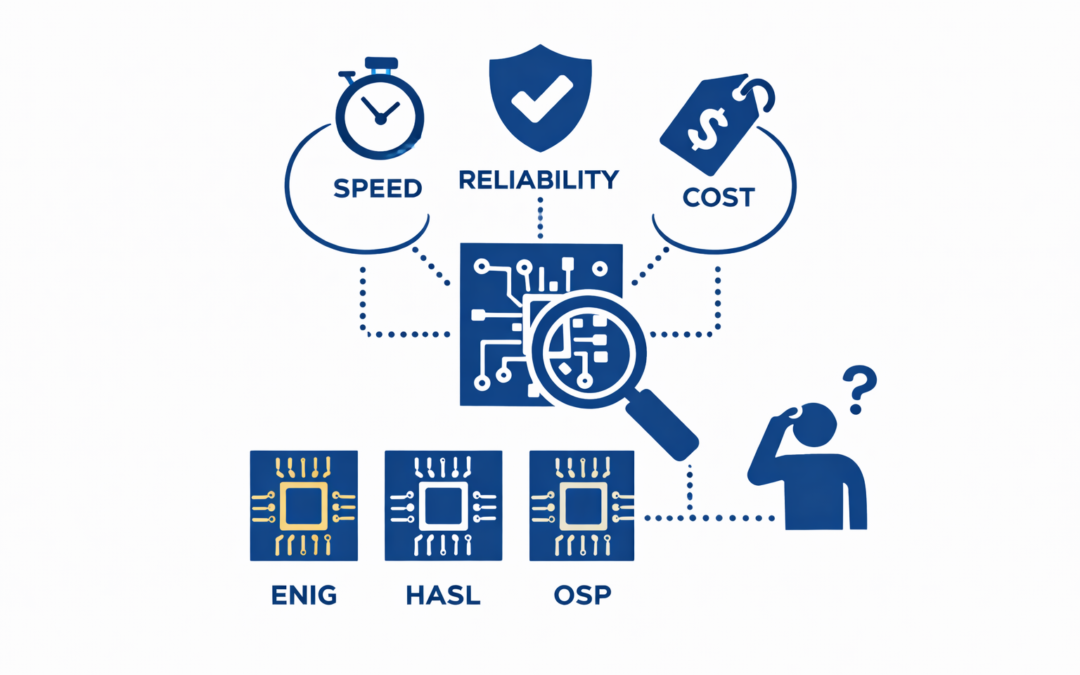
Choosing the Right Surface Finish for Your PCB Project – Based on Performance Needs
Performance Needs
For high-frequency applications, a smoother finish is essential for top performance.
When designing PCBs for high-frequency applications, such as RF (Radio Frequency) and microwave circuits, one of the critical considerations is the choice of the surface finish. The finish you select can significantly impact the electrical performance, particularly at higher frequencies where signal integrity becomes more critical. Here’s a detailed explanation of why a smoother finish is essential for high-frequency applications:
1. Importance of Surface Smoothness in High-Frequency Applications
High-frequency signals, which typically range from megahertz (MHz) to gigahertz (GHz), are highly sensitive to surface irregularities and roughness. Here’s why:
- Skin Effect: At high frequencies, electrical currents tend to flow along the outer surface of a conductor rather than through its core. This phenomenon is known as the skin effect. A rough surface can increase the path length that the signal has to travel, causing increased resistance and energy loss. This results in higher insertion loss, which is undesirable in high-frequency circuits.
- Signal Reflection and Scattering: Surface roughness can cause signal reflections and scattering, which degrade signal integrity. In high-frequency PCBs, even minor imperfections can cause significant reflection and signal loss because the wavelength of the signals is comparable to the size of the surface roughness. A smoother surface minimizes these effects, ensuring cleaner signal transmission.
- Impedance Control: Precise impedance control is crucial in high-frequency circuits to ensure signal integrity and prevent reflections. Surface roughness can affect the dielectric properties of the PCB material and alter the impedance. A smoother finish helps maintain consistent impedance across the board, essential for high-speed digital and RF applications.
2. Preferred Finishes for High-Frequency Applications
Given the importance of smoothness in high-frequency applications, certain PCB finishes are more suitable:
- Electroless Nickel Immersion Gold (ENIG): ENIG is a popular choice for high-frequency PCBs due to its smooth and flat surface. The gold layer provides excellent conductivity and solderability, while the nickel layer provides good protection against oxidation. The smoothness of ENIG minimizes insertion loss and signal distortion, making it ideal for RF and microwave applications.
- Immersion Silver: Immersion Silver also provides a relatively smooth surface and good conductivity, making it suitable for high-frequency applications. It offers a good balance between performance and cost, although it may require careful handling to avoid tarnishing.
- Immersion Tin: Immersion Tin can provide a reasonably smooth surface suitable for high-frequency applications. However, it is less commonly used due to concerns about tin whiskering and lower corrosion resistance compared to other finishes like ENIG or Immersion Silver.
- Hard Gold: Hard Gold is known for its excellent wear resistance and conductivity. It is often used in high-frequency applications that require high durability and minimal signal loss, such as connectors and contact points.
3. Impact of Surface Finish on Signal Integrity
In high-frequency applications, maintaining signal integrity is paramount. The smoother the finish, the less likely it is to introduce unwanted variations in the signal path. Here’s how different finishes impact signal integrity:
- Reduced Losses: A smoother finish reduces resistive and dielectric losses that occur when signals pass through or across a surface. This is particularly important for maintaining the integrity of signals in RF and microwave frequencies, where losses can significantly affect performance.
- Minimized Crosstalk: Crosstalk occurs when signals in adjacent traces interfere with each other, which can be exacerbated by rough surface finishes. A smoother surface minimizes crosstalk by providing a more uniform electromagnetic field distribution, thus preserving signal integrity.
- Lower Capacitance Effects: High-frequency signals are also affected by parasitic capacitance caused by surface roughness. A smoother finish helps reduce these effects, which is crucial for maintaining signal speed and preventing delays or distortions.
4. Role of Surface Finish in Manufacturing and Reliability
A smoother surface finish not only enhances electrical performance but also improves the reliability and manufacturability of high-frequency PCBs:
- Solderability: Smooth finishes like ENIG or Immersion Silver provide excellent solderability, essential for reliable component mounting and assembly. This reduces the risk of defects such as solder bridges or poor joint quality, which can impact high-frequency performance.
- Consistency and Repeatability: A smooth surface finish ensures consistent PCB performance across different production batches. This is crucial for high-frequency applications where even slight variations can affect performance. A consistent finish allows for predictable electrical characteristics and reliable impedance control.
Conclusion
For high-frequency PCB applications, choosing a finish that provides a smooth surface is crucial for optimizing performance. Finishes like ENIG, Immersion Silver, and Hard Gold are often preferred because they provide a flat, smooth surface that minimizes signal loss, maintains signal integrity, and supports precise impedance control. These factors are essential for ensuring the reliable and efficient operation of high-frequency circuits in various applications, such as telecommunications, aerospace, and advanced computing.
CategoriesGeneral
Ciright Announces Total Integration For Your Accounting Software
We are proud to announce open platform integration for accounting tools. System One can interface with QuickBooks, Microsoft Great Plains, MAS 90, or any open platform accounting system where CSV files can be exchanged through general ledger and accounted for with...
Ciright Releases Milk Route Application
Ciright announces the availability of the Milk Route Application. The Milk Route App provides the salesman the proximity of other customers that are close by the customer he is currently meeting with that particular day. Milk Route generates the locations of these...
Ciright Releases Estimating Toolset
Ciright announces the availability of estimating toolset that provides an integrated estimating process and eliminates any fragmented spreadsheets. The program consolidates all estimating within one resource to be shared by the enterprise in which an estimate is then...
Generate a Proposal in a Third of the Time with Ciright’s Proposal Generation Tool
Ciright announces the availability of Proposal Generation Tool, providing the ability to generate a proposal based off the actual products and services provided by the company. Traditional proposal generation can take the user three to four times the amount of time...
Ciright Solution Available For Public Adjustors
We are happy to introduce our Mobile Published Adjustors Application so that a public adjustor can go out to an accident and assess the information to process a claim on the spot. Results can be delivered in real-time, quickly and efficiently.
Ciright Announces Release of Compensation Software
Ciright announces full integration of Compensation Software. The enterprise is now able to quantify gross contribution of each employee in the sales environment across the enterprise, specifically, in situations in which multiple parties and players are among a...
Recent Comments